


At ASKA Company, we have accumulated a wealth of proprietary expertise essential for manufacturing our products.
In this issue, we would like to introduce one of our latest initiatives: "Sensing Molds," designed to capture and understand the precise conditions within the mold during production.
What is a Sensing Mold?
A Sensing Mold is a next-generation mold equipped with various internal sensors to "visualize and quantify" behaviors during the molding process—elements that were previously considered a "black box."
By capturing minute changes during molding in real-time, we aim to establish mold design and molding technologies based on empirical data, moving beyond a reliance on the "experience and intuition" of skilled technicians.
Background: Tackling Gas-Related Defects
In injection molding, "gas" generated by the thermal decomposition of resin is a major cause of product burns (diesel effect), short shots, and mold deposits.
However, because the behavior of gas inside a mold cannot be seen with the naked eye, countermeasures have traditionally been reactive—only possible after a problem occurs.
By sensing this gas behavior, we aim to scientifically clarify "why defects occur." Our goal is to shorten development lead times and boost productivity through proactive measures.
To achieve this, we have designed and manufactured a specialized mold specifically engineered to house these sensors for verification.
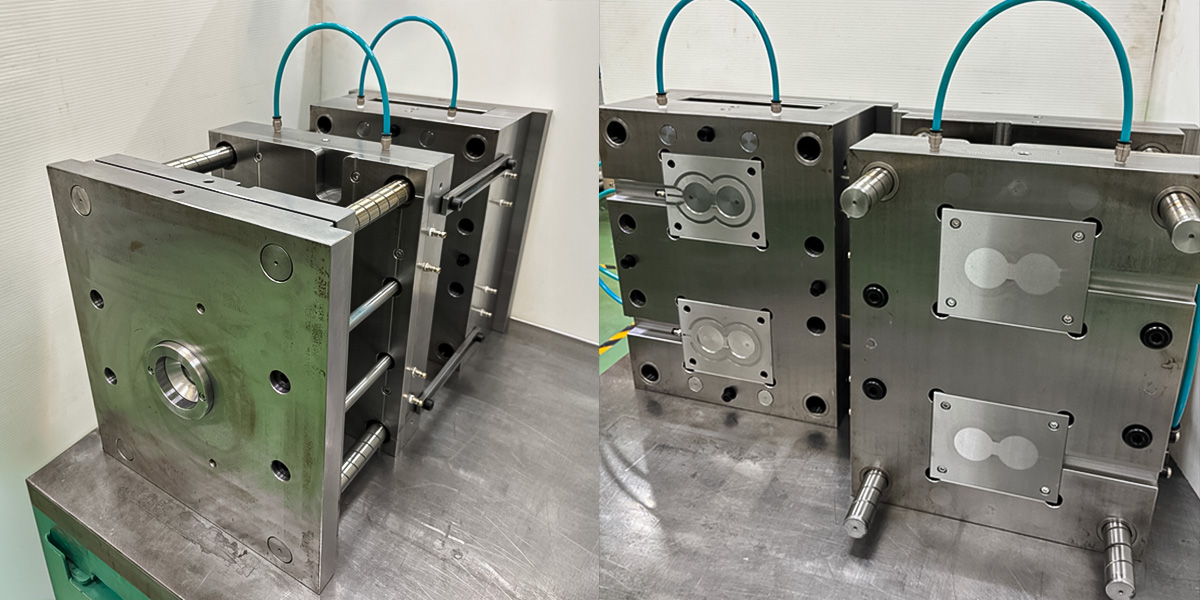
Our newly developed verification mold
Verification Experiment: Utilizing Gas Flow Sensors
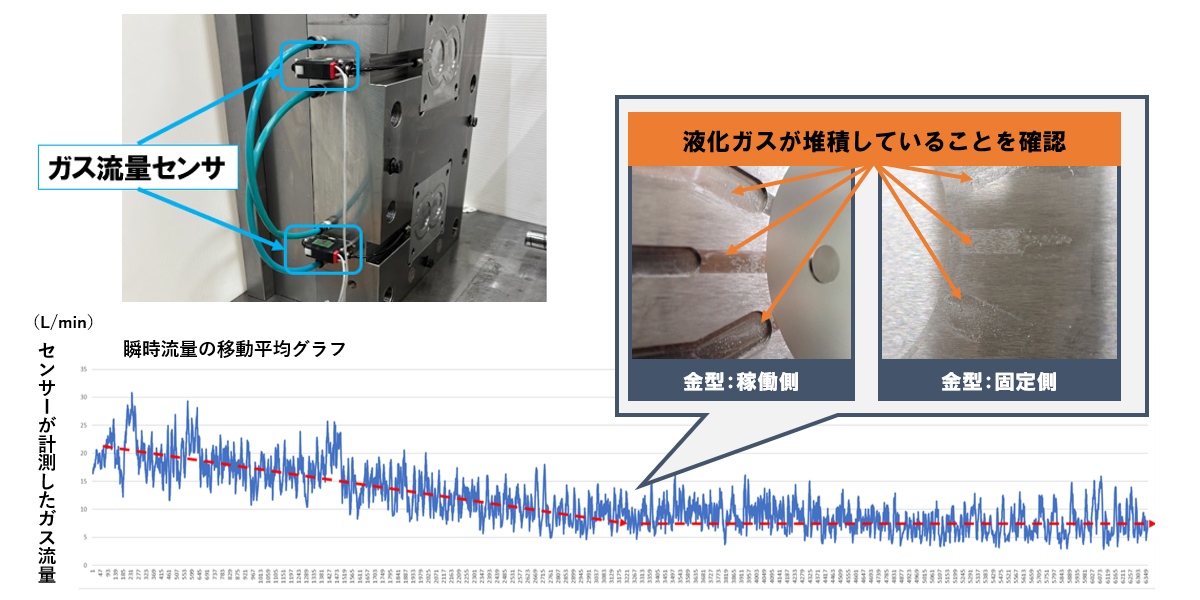
We conducted a verification experiment by integrating gas flow sensors into a mold.
Implementation Details
For this project, we newly designed and manufactured a specialized mold capable of housing these sensors. We measured the gas discharge volume and flow velocity during molding to verify their correlation with "gas traps" (burns) occurring on the actual molded parts.
Results
The timing of gas accumulation within the mold matched the fluctuations in the numerical data detected by the sensor. We successfully captured the phenomenon of "gas stagnation" as realistic, evidence-based data.
Based on these results, we have determined that it is now possible to logically evaluate the optimal position and required capacity for gas vents.
Future Outlook: Optimizing Maintenance
Moving forward, we plan to further deepen this sensing technology to achieve the following:
Visualizing Mold Maintenance:
By using sensors to detect the accumulation of gas-related deposits, we aim to predict the optimal timing for mold cleaning.
This will prevent sudden line stoppages and maximize equipment uptime (overall equipment effectiveness).
Conclusion
Through these experiments in mold processing and sensing, we have tackled the challenge of gas-related defects from a perspective entirely different from our daily operations.
We remain committed to ongoing research to create high-productivity molds. Our goal is to refine these findings and successfully integrate sensing technology into our full-scale production molds.