

At Aska Company, we have been conducting company-wide QC circle activities (small-group improvement activities) under the name "MK Activities" for nearly 50 years.
Teams are formed across all departments—from the manufacturing floor to administrative sectors—to tackle daily improvements based on our core philosophy of "Raku, Sei, Sou, An" (Comfortable, Correct, Fast, and Safe). This continuous drive for improvement is woven into the very DNA of ASKA Company.
In this issue, we would like to share a "new wave" that is currently transforming these traditional MK Activities.
Fertile Ground for Data Affinity: The Foundation of MK Activities
QC circle activities are fundamentally about improvement. In our MK Activities, defining target issues and expressing results must never rely on mere effort or intuition; instead, we must "speak with data."
What is the current baseline? How much improvement has been achieved?
To objectively prove these points, expressing outcomes through data has become second nature to us.
Furthermore, it is not enough to simply collect data; it is crucial to stratify and analyze it in various ways.
At Aska Company, many employees take the QC Examination (Quality Control Examination), and we provide internal education on tools like the "Seven Basic Tools of Quality (QC7)."
As a result, our team possesses a wealth of knowledge regarding data analysis.
This daily interaction with data—not only in MK Activities but also in routine operations—has created a highly receptive environment with a strong affinity for "digitalization."
However, when transitioning to the phase of processing collected data and "automating" routine tasks, we have traditionally run into a certain "wall."
The "Programming Wall": A Major Hurdle Causing Dependency on Specific Individuals
That wall is "the presence or absence of programming skills."
For example, suppose a team wants to automate the process of aggregating daily production data to generate a report. In the past, creating such automation tools required writing code using programming languages like VBA macros for Excel or GAS (Google Apps Script) for Google Sheets.
This inevitably involves a high learning cost.
"We want to make improvements, but since we can't write code, we have no choice but to keep doing it manually."
"There is only one person in the department who knows how to do it, but we can't ask them when they're too busy."
"If that person transfers to another department, nobody will be able to maintain the tools they built."
As these examples show, traditional digital improvements depended heavily on individual technical capabilities.
Consequently, the more advanced a tool became, the more it turned into a "black box" that only a specific person could create or fix. When that person left, the team would eventually stop using the tool simply because they couldn't modify it—a recurring and frustrating cycle
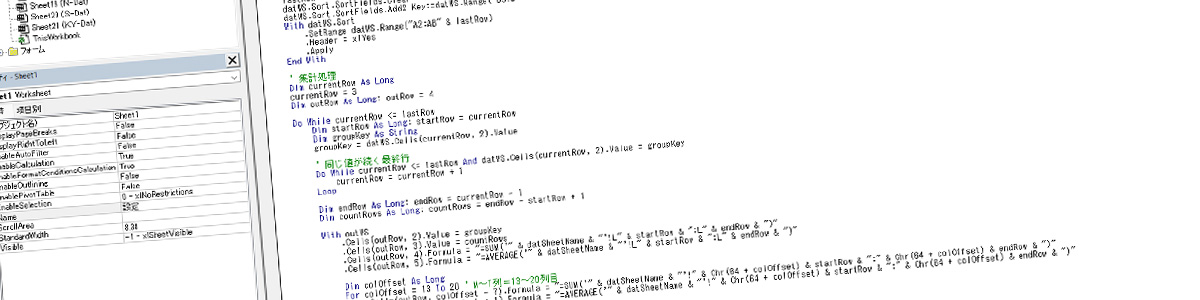
特定の人しかわからないVBAの例
"Mastering AI as a Tool" Through the Lens of QC Thinking
This is where AI comes into play.
With the advent of generative AI like ChatGPT and Gemini, we have entered a world where "humans no longer necessarily need to write code themselves."
All that is required is a "prompt" (a set of instructions) telling the AI what you want to achieve. Because these prompts can be written in natural language, creating programs has now become an extension of everyday communication.
However, crafting effective prompts requires a strategic approach.
You must meticulously organize and communicate details—such as what data exists where and how it should be utilized. Interestingly, this logical structuring shares a strong affinity with QC thinking, which relies heavily on flows, matrices, and methodical analysis.
By leveraging AI to break through the programming wall, our initiative of "building tools to improve our own operations" has evolved. Teams can now develop and refine every detail of these tools entirely on their own.
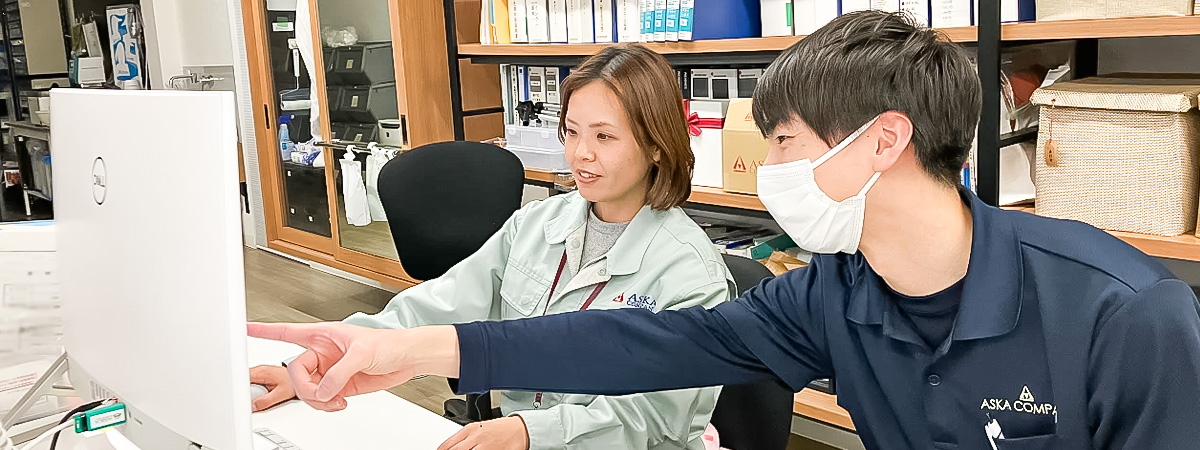
Discussion on Prompt Creation
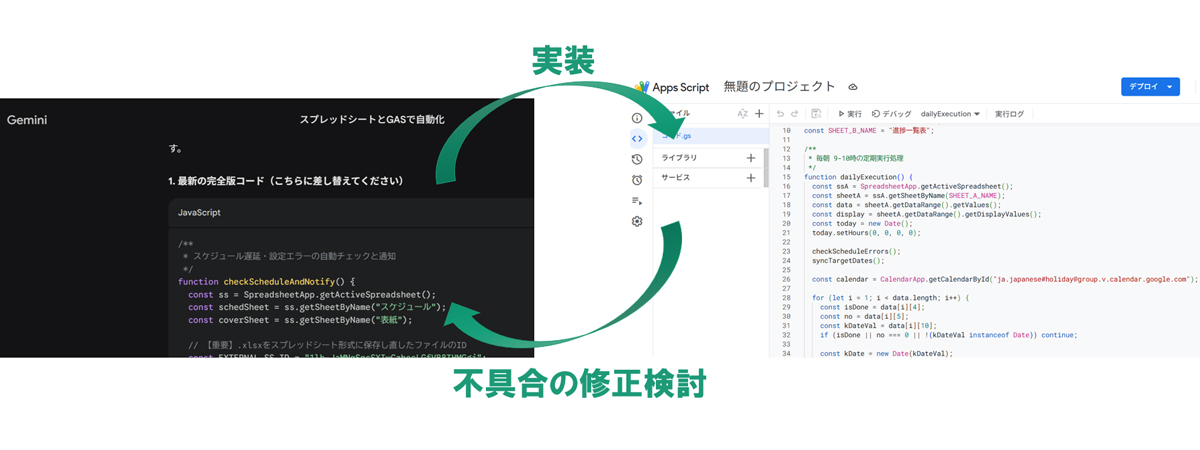
Furthermore, it has become remarkably easy not just to aggregate data, but also to integrate it with other applications.
A simple yet effective example implemented by our team is a complex schedule management function: when data is entered into a spreadsheet, a notification is automatically triggered in Google Chat, allowing users to instantly review the relevant details directly via the provided link.
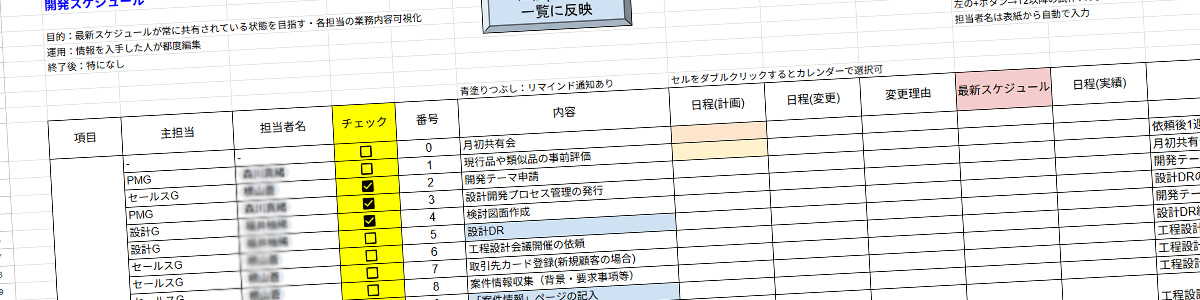
The Actually Implemented Schedule Management Function
The Future of MK Activities
By equipping ourselves with the powerful tool of AI, Aska Company’s MK Activities have evolved into a system that no longer depends on individual technical skills.
The name "MK Activities" is originally derived from our core philosophy: "Minna de Katsudou, Minna de Kaizen" (Activity by Everyone, Improvement by Everyone).
By liberating our improvement activities from the constraints of specialized technical skills, we are drawing closer to our ideal vision of full, unconditional participation by all members.
This is the new shape of Kaizen—a seamless fusion of digital technology and human wisdom.
Please look forward to the innovative results our teams will deliver in the future.